Travel Guide
How to Visit Neuschwanstein Castle — The Complete 2026 Guide
There are roughly 1.4 million people who visit Neuschwanstein each year. Most of them spend more time in queues than inside. Here's how not to be one of them.
4.9/5 on TripAdvisor
Money-Back Guarantee
Since 2004
No Hidden Extras
The castle you see on every postcard was never actually finished — and that's what makes the interior tour so fascinating.
What You'll See Inside Neuschwanstein
Most people expect a fairy-tale castle and get one. What they don't expect is the scale of what King Ludwig II managed to build — and the strange poignancy of how much he left unfinished when he died in 1886 at age 40.
The interior tour covers roughly a dozen rooms, each one a visual argument about how a 19th-century king imagined the medieval world. The Throne Room is perhaps the most arresting: a two-storey Byzantine basilica rendered entirely in gold, lapis lazuli, and intricate mosaic. Ludwig designed it as a sacred space — the throne itself was never installed, which gives the room a haunting, expectant quality, as if the ceremony is perpetually about to begin.
The Singer's Hall on the top floor was built for performance, not for actual performances. Ludwig hosted no concerts there during his lifetime. The room was inspired by Tannhäuser and Lohengrin — the Wagner operas that Ludwig loved obsessively — and every surface tells a story from Germanic legend. The ceiling appears to float, lit by a system of windows that transforms with the quality of the Alpine light outside.
Ludwig's private chambers are the most intimate part of the tour: a bedroom that took fourteen craftsmen four and a half years to complete, covered in carved oak Gothic tracery so intricate it's almost painful to look at closely. The study walls are covered in scenes from the legend of Tristan and Isolde. The kitchen — one of the most technologically advanced rooms in 1880s Bavaria — still has its original running water system and mechanical spit roast.
None of this was built for guests. Ludwig lived here alone for fewer than 200 nights before his death. The castle that has since welcomed over 60 million visitors was meant, by its creator, to be entirely private.
UNESCO World Heritage Status (July 2025)
In July 2025, all three castles built by King Ludwig II of Bavaria — Neuschwanstein, Linderhof, and Herrenchiemsee — were inscribed on the UNESCO World Heritage List. The designation recognizes them as outstanding examples of 19th-century Historicism: a movement in which architects and patrons deliberately recreated historical styles to express deeply personal or political visions of the past.
For Neuschwanstein specifically, UNESCO cited the castle's extraordinary synthesis of Romanesque architecture, Wagnerian iconography, and cutting-edge 19th-century engineering. The building that looks like a medieval fantasy was in fact fitted with central heating, running water, and a telephone line — Ludwig insisted on modernity hidden inside the myth.
The practical consequence of UNESCO status: demand has increased significantly. Visitors who assumed they could simply turn up and see the castle have found themselves looking at a sold-out sign. Advance planning is no longer optional.
Getting There: The Reality
The journey from Munich to Neuschwanstein involves more decisions than most visitors anticipate. The nearest train station is Füssen, roughly 130km southwest of Munich — a journey that requires at least one change and takes the better part of three hours each way. From Füssen, the castle is still several kilometres and an uphill walk away.
The logistics layer on top of each other quickly. Which train? Which connection? Where do you buy the castle tickets — and by the time you've figured that out, are they still available for your chosen time? The path to the Marienbrücke bridge is popular, but it splits, and the wrong fork wastes significant time. German signage is helpful if you read German.
None of this is impossible. But it turns a day that should feel effortless into one that requires constant navigation decisions. When something goes wrong — a delayed train, a fully-booked tour slot, wrong directions at the castle gate — there is no one to call.
A private tour from Munich solves all of this in one arrangement. Your guide handles the tickets, drives you directly, walks you up to the castle, leads the interior tour with the local knowledge that transforms what you're seeing, and has contingency plans for every scenario. You arrive at the castle already knowing the story of the room you're about to enter.
Marienbrücke, the Alpsee, and Hohenschwangau
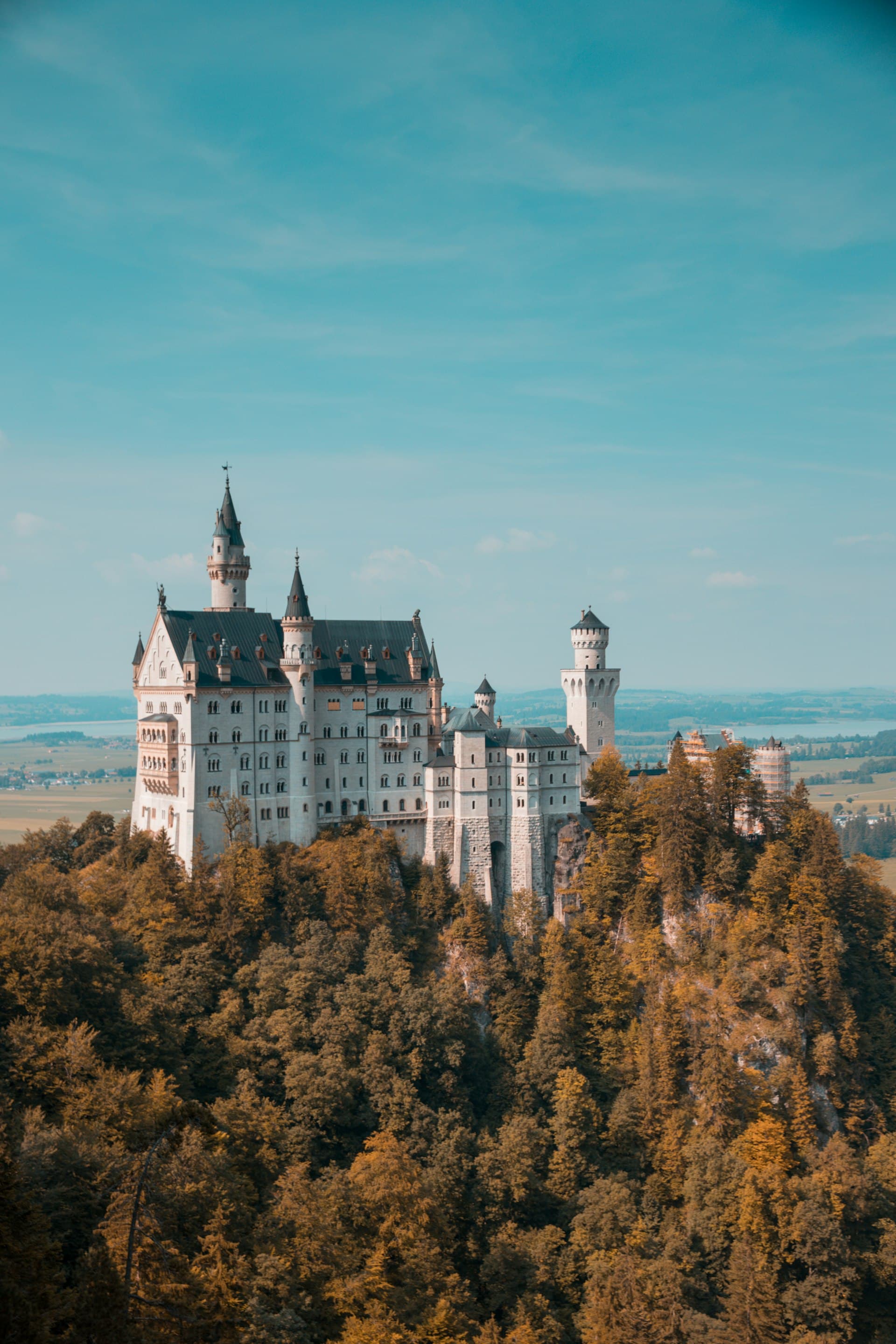
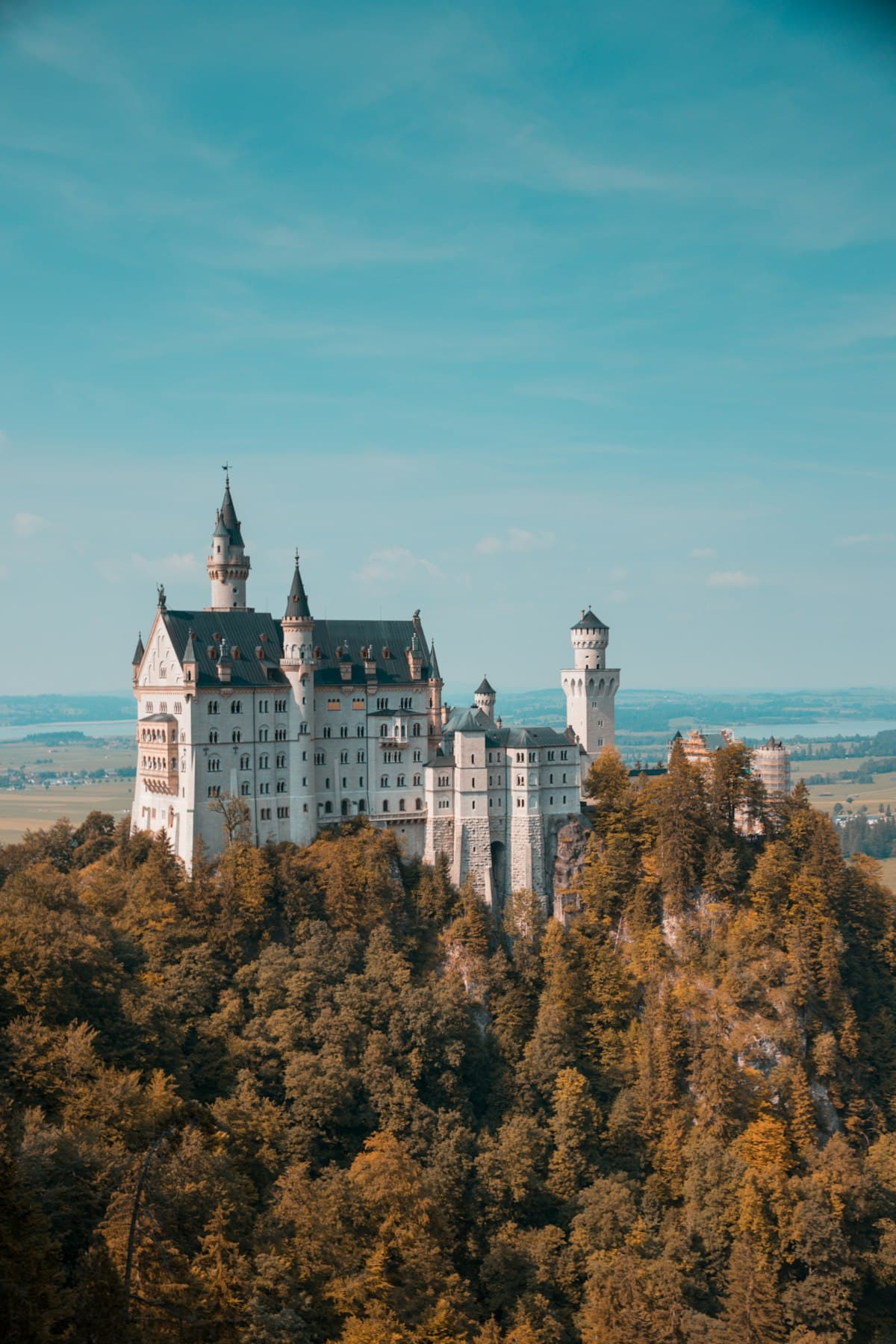
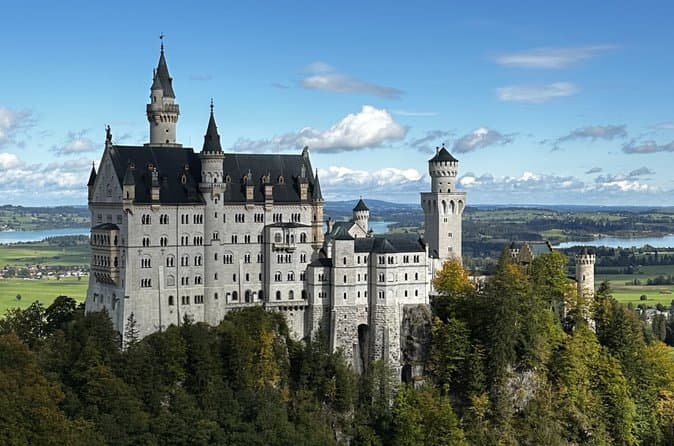
The most photographed view of Neuschwanstein isn't from ground level — it's from the Marienbrücke, a narrow suspension bridge that spans a gorge about 90 metres above a waterfall, directly in front of the castle's most photogenic face. On a clear morning, with the Alps behind and the castle filling the frame, it produces the image that has appeared on more postcards than perhaps any other in Germany.
The bridge is worth the detour, but it also draws crowds. Understanding when and how to approach it — and which route to take back — makes the difference between a meditative moment and a shuffle through a bottleneck.
The Alpsee lake at the base of both castles has a completely different character: quiet, reflective, the kind of place where you can sit on a bench and let the morning settle. Swans drift past. The castle appears in the water when it's still. It's one of those places that rewards going slowly.
Hohenschwangau Castle, across the valley, was where Ludwig spent his childhood. His father, Maximilian II, had it restored in the 1830s as the family's summer residence. It's smaller and less dramatic than Neuschwanstein, but the connection between the two castles — one a childhood home, one a lifelong obsession — gives the landscape a biographical dimension that makes both more meaningful.
Best Season to Visit
Each season offers a different Neuschwanstein. The question is which version you want.
Autumn (September–October) is the most consistently rewarding. The beech forests on the surrounding slopes turn amber and gold, the light softens, and the weather is cool enough for walking without being unpredictable. Crowds begin to thin after mid-September. This is when local guides most often choose to visit on their days off.
Spring (April–June) brings the Alpine meadows to life. The castle against snow-capped peaks in late April or early May, with wildflowers in the foreground, is a genuinely beautiful combination. Early spring can be cold, but visitor numbers are lower, and the quality of light in the morning hours is exceptional.
Summer (July–August) is the most crowded period by a considerable margin. The interior tours are heavily subscribed, the path to the Marienbrücke is frequently congested, and the village below the castle can feel overwhelmed. If summer is your only option, the experience is still extraordinary — the landscape doesn't care how many people are looking at it — but the logistics require more care.
Winter (November–February) is dramatically underestimated. Snow on the towers and forest creates the image that Ludwig himself was dreaming of when he drew the first sketches. Visitor numbers drop sharply. The cold is manageable if you dress for it. The castle interior is the same magnificent oddity in any weather.
Why a Local Guide Changes the Visit
The official guided tour of Neuschwanstein lasts 30-40 minutes and covers the facts. A guide from European Castles Tours covers what the facts point toward.
We work 5km from this castle. Several of our guides have been leading tours here for more than a decade. They know which detail in the Throne Room Ludwig obsessed over for years, why the Singer's Hall was designed to be heard from, and what the unfinished rooms in the upper floors say about the last years of the king's life. They also know which viewpoints are worth the walk and which are simply popular.
Our tours include pre-secured timed-entry tickets. You don't queue at the ticket office. You don't refresh a website hoping for a slot to open. You arrive at the time we've arranged and you walk in.
“I've been to many castles in Europe. Neuschwanstein is the only one where I genuinely forgot to take photos for the first ten minutes.”
Patricia H., Chicago
“Having a local guide who knows the stories behind every room made it feel like a private audience with Ludwig II himself.”
Robert & Claire, Melbourne
“We'd tried to visit on our own two years earlier and barely got inside. With European Castles Tours it was completely different.”
Thomas K., Toronto
Written by
European Castles Tours
A family-run tour company based 5km from Neuschwanstein Castle since 2004.
Quick Answer
How do I visit Neuschwanstein Castle?
Neuschwanstein Castle is a UNESCO World Heritage Site in Bavaria, Germany. The interior can only be visited on a 30-40 minute guided tour. Tickets sell out weeks in advance. The easiest way is a private tour from Munich (1h45 drive) that handles tickets, transport, and timing — so you enjoy the castle instead of the logistics.
Common Questions
Frequently Asked Questions
The official guided interior tour lasts 30-40 minutes. Allow an additional 30-40 minutes for the walk uphill from the village, and extra time to explore the Marienbrücke bridge viewpoint and the Alpsee lake below. Most visitors spend 3-4 hours in the area total. On a private day tour from Munich, the full day (including travel) is typically 10-11 hours.
Late September through October offers the most dramatic scenery — golden forest, cooler temperatures, and softer light for photography. Late spring (May-June) is also beautiful before peak summer crowds arrive. Winter visits have a special fairy-tale quality with snow, though some viewpoints may be slippery. Summer (July-August) sees the highest visitor numbers and the longest waits.
No. The interior of Neuschwanstein is only accessible on an official guided tour. These tours are timed-entry and strictly limited in group size. They cannot be entered spontaneously — tickets must be secured in advance, and on busy days they sell out completely.
The interior tour involves multiple staircases and is unfortunately not wheelchair accessible. The surrounding grounds and the view of the castle from the village below are accessible. Some viewpoints along the uphill path are reachable by horse-drawn carriage. We recommend contacting us in advance if accessibility is a concern so we can plan accordingly.
Hohenschwangau Castle — King Ludwig II's childhood home — sits just across the valley and is equally worth visiting. The Marienbrücke suspension bridge offers the classic postcard view of Neuschwanstein. The Alpsee, a glacial lake at the foot of the castles, is beautiful for a short walk. The village of Füssen, just 4km away, has a medieval center and its own castle.
Absolutely. Snow transforms the castle into something that looks lifted from a Grimm fairy tale. Crowds are dramatically thinner between November and February. The surrounding Alps take on a completely different character, and the low winter light is extraordinary for photography. The interior tour runs year-round (with a short closure around Christmas).
Neuschwanstein is approximately 130km southwest of Munich — about 1 hour 45 minutes by car under normal conditions. By public transport the journey involves multiple changes and takes around 2.5-3 hours each way. For a day trip, a private car with a guide eliminates the routing complexity and gives you maximum time at the castle itself.
Yes. In peak season (June-September) interior tour tickets often sell out 4-6 weeks in advance. Even in shoulder seasons, same-day availability is rare and unreliable. Our tours include pre-secured timed-entry tickets as part of the package — you never arrive to find the interior sold out.
Explore These Places
Related Tours
Keep Reading
More From the Blog
Best Neuschwanstein Photography Spots — A Photographer's Guide
The photographs that made Neuschwanstein famous were taken from specific places at specific times of day. Here is what each viewpoint offers — and why the best shots happen when you know where to stand.
Travel GuideIs Neuschwanstein Castle Worth Visiting? — An Honest Answer
Every year, travelers ask whether Neuschwanstein lives up to its reputation. The honest answer is: it depends entirely on how you visit. Done right, it is one of the most extraordinary days in European travel.
Seasonal GuideChristmas Markets and Castle Tours in Bavaria — A Winter Fairy Tale
Bavaria in December is a different country. Neuschwanstein in snow and Nuremberg's Christmas market in candlelight are two of the most extraordinary winter experiences in Europe — and they are an hour apart.